If you run a home care agency, you’ve probably had this conversation more than once: someone asks whether your software is “EVV compliant,” and the honest answer is a little more complicated than yes or no. That’s not a knock on your agency. EVV compliance isn’t a single checkbox. It’s a set of requirements that touch your scheduling process, your state’s Medicaid system, and often a third-party aggregator you may not interact with directly but whose rules still apply to you.
This article breaks down what EVV actually requires, where scheduling software fits into that picture, and where it doesn’t. If you’re evaluating tools right now, or just trying to make sure your current process holds up, this should give you a clearer, more accurate picture than most vendor pages will.
What EVV Actually Requires (the Six Data Elements)
EVV, or Electronic Visit Verification, comes from the 21st Century Cures Act, which requires states to verify visits for Medicaid-funded personal care and home health services using electronic data rather than paper timesheets. At the federal level, an EVV record needs to capture six specific data elements:
- The type of service performed
- The individual receiving the service
- The date of the service
- The location where the service was delivered
- The individual providing the service
- The time the service begins and ends
Notice that GPS location is only one of six required elements. A scheduling app that captures a caregiver’s location but doesn’t clearly tie that check-in to the right patient, service type, and time window isn’t fully solving the EVV problem, even if it feels like it is.
Why EVV Compliance Isn’t Just a Software Feature
Here’s the part that catches a lot of agencies off guard: the federal Cures Act sets the six required data elements, but it leaves the implementation details to each state. That means EVV compliance depends heavily on which state (or states) you operate in, not just which software you use.
The Two EVV Models States Use (Open vs. Closed)
Most states implement EVV using one of two models:
Closed model: The state selects a single EVV system that all providers in that state must use, either directly or by integrating with it. Your scheduling software, in this case, typically needs to send data into the state’s chosen system rather than serve as the EVV system itself.
Open model: Providers can choose their own EVV solution, as long as it can transmit the required data to the state’s designated aggregator (a middle layer that collects and validates EVV data across multiple vendors before it reaches Medicaid). This gives agencies more flexibility, but it also means “our software supports EVV” isn’t a complete answer. It supports EVV in a way that has to connect properly to your specific state’s aggregator.
This is exactly why we’re careful about how we describe CareHudl’s role here: whether you’re in an open-model or closed-model state changes what “EVV compliant” actually requires from your software, and no vendor can honestly promise blanket compliance without knowing which state, or states, your agency operates in.
How Scheduling Software Fits Into Your EVV Compliance Workflow
Scheduling software plays a real and important role in EVV, just not the entire role. Here’s a more accurate way to think about it:
What good scheduling software should do:
- Capture the visit-level data (caregiver, patient, service type, time, location) accurately and in real time
- Make it easy for caregivers to check in and out correctly, without confusing workflows that lead to missed or late verifications
- Flag exceptions (a visit that starts late, a check-in with no matching check-out, a location mismatch) so your office team can catch problems before they become compliance issues
- Transmit or export data in a format your state’s EVV system or aggregator can actually use
What scheduling software alone typically can’t do:
- Guarantee your agency is compliant with your specific state’s EVV program, since that also depends on proper integration with the state aggregator, correct billing alignment, and your agency’s own documentation practices
- Replace the need to confirm your state’s specific EVV requirements, which can change and don’t always match what a national vendor’s marketing page implies
If a vendor tells you their software alone makes you EVV compliant regardless of state, that’s worth a follow-up question, not automatic trust.
Common EVV Compliance Mistakes Home Care Agencies Make
A few patterns show up again and again when EVV processes break down:
- Assuming GPS alone equals EVV. Location is one of six required elements, not the whole requirement.
- Not confirming the state’s model. Agencies operating across state lines sometimes assume the same setup works everywhere; open and closed model states often need different configurations.
- Letting exceptions pile up. A missed check-out or a location mismatch that isn’t corrected quickly can turn into a documentation gap that surfaces during an audit, long after anyone remembers the details of that specific visit.
- Treating EVV as a one-time setup instead of an ongoing process. State requirements and aggregator integrations can change; a system that was compliant at implementation can drift out of alignment if nobody’s watching for updates.
Questions to Ask When Evaluating “EVV Compliant” Scheduling Software Claims
Whether or not you’re looking at CareHudl specifically, these questions tend to separate vendors who understand EVV from ones using it as a buzzword:
- Which EVV model does our state use, open or closed, and how does your software handle that specifically?
- Can you show us how the six required data elements map to fields in your system?
- How does your software transmit data to our state’s aggregator, and who’s responsible if that connection breaks?
- How are exceptions (missed check-ins, location mismatches) surfaced to our office staff?
- If our state changes its EVV requirements, how quickly can your system adapt?
A vendor who answers these specifically, rather than repeating “we’re EVV compliant” as a slogan, is a good sign.
How CareHudl Supports EVV-Compliant Scheduling and Verification
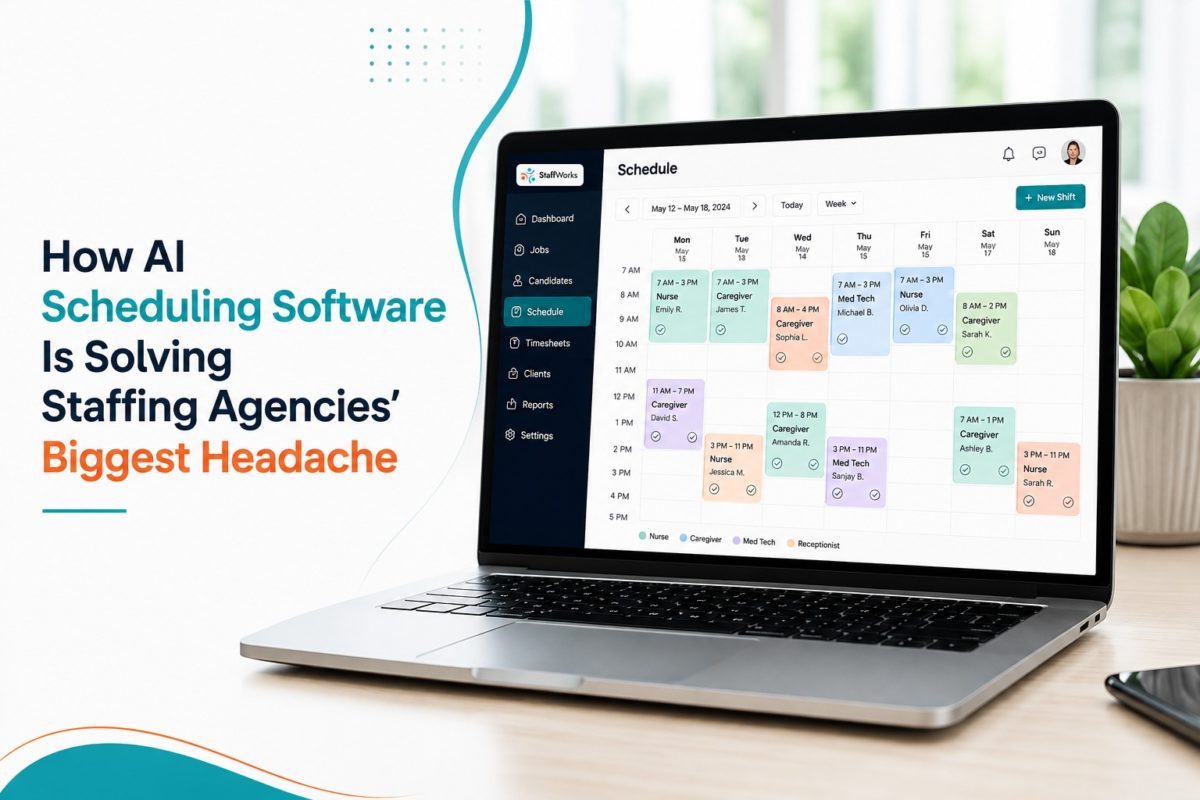
CareHudl is built to capture accurate, time-stamped, location-verified visit data as part of its core scheduling workflow, which is the foundation any EVV process depends on. CareHudl’s geo-intelligent scheduling uses caregiver location as part of the caregiver-to-patient matching process, while its visit workflow captures the time, location, and other visit information needed to support EVV processes.
That said, we want to be direct about this: CareHudl supports EVV-compliant scheduling and verification workflows, it doesn’t replace the need to confirm your specific state’s EVV requirements or your integration with your state’s aggregator. Our team works with agencies to understand their state’s model and make sure the data CareHudl captures lines up with what that state actually requires, rather than assuming a one-size-fits-all setup.
If you’re not sure whether your current process holds up, that’s a reasonable thing to ask us, or any vendor, about directly.